Dear learners, welcome to the first lesson in our series on the Fundamentals of Cancer. I’m Balisa Mosisa, and today, we’ll explore the first lesson on basics of cancer biology, which is an essential step in understanding one of the most challenging diseases of our time called cancer.

Contents of this lesson are:
Ø Definition of cancers
Ø Prevalence and common types of cancers
Ø Differences among normal and cancer cells
Ø Initiation and Development of cancer
1.1.DEFINITION OF CANCERS
What exactly is ‘cancer’?
Cancer is not a single disease; it is a group of diseases characterized by uncontrolled cell growth, invasion into surrounding tissues, and the potential to spread to distant organs. This occurs when normal regulatory mechanisms that control cell growth and death are disrupted.

1.2.PREVALENCE OF CANCER
Cancer is one of the challenging diseases humanity has been struggling throughout every page of history till today. It is a leading global health challenge, with its prevalence varying across regions due to differences in lifestyle, genetic factors, and healthcare access.
According to the International Agency for Research on Cancer (IARC) 2023 data, there were approximately 20 million new cases and 10 million cancer-related deaths worldwide annually. The most common cancers according to recent data include lung, breast, colorectal, and prostate cancers.

Prevalence is higher in high-income countries but rising in low- and middle-income regions due to aging populations and lifestyle changes.

Most prevalent cancer types:
Even though there are several cancer types that we are going to address in detail in lesson three, the following are the most prevalent cancer types: Lung, breast, colorectal, and prostate cancer.

1.3.RISK FACTORS OF CANCERS
A risk factor for cancer is any substance or condition that increases the chance of developing cancer. Some risk factors can be changed, while others cannot.
Risk factors associated with various types of cancer:

1. Lifestyle-Related Risk Factors
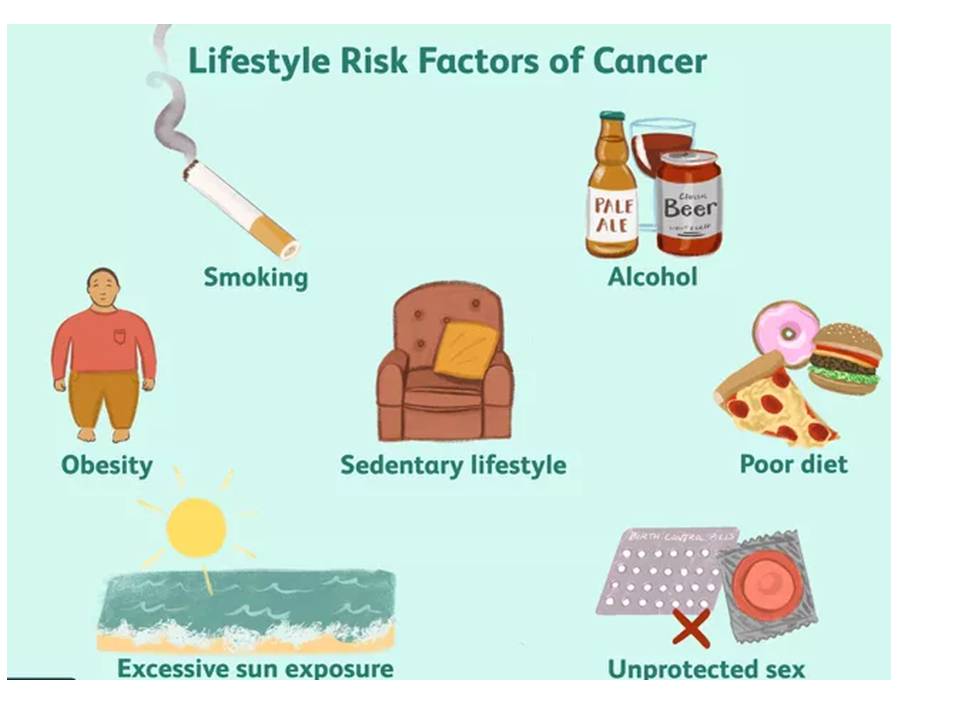
- Tobacco Use: Smoking and smokeless tobacco significantly increase the risk of lung, mouth, throat, and other cancers.
- Alcohol Consumption: Heavy drinking raises the risk of cancers of the liver, breast, esophagus, and mouth.
- Diet: High-fat, low-fiber diets, and diets low in fruits and vegetables may increase cancer risk.
- Obesity: Linked to higher risks of breast, colon, kidney, pancreatic, and other cancers.
- Physical Inactivity: Sedentary lifestyle contributes to cancer risk, particularly breast and colon cancer.
2. Environmental and Occupational Risk Factors

- Exposure to Carcinogens: Asbestos, benzene, and radon are known carcinogens.
- Radiation: Exposure to UV radiation from the sun and ionizing radiation increases cancer risk.
- Air Pollution: Linked to lung and other cancers.
3. Biological and Hormonal Risk Factors
- Viruses and Infections:
- Human papillomavirus (HPV) – cervical and throat cancers.
- Hepatitis B and C – liver cancer.
- Epstein-Barr virus – certain lymphomas and nasopharyngeal cancers.
- Helicobacter pylori – stomach cancer.
- Hormonal Imbalances: Estrogen exposure increases the risk of breast and uterine cancers.
4. Genetic Risk Factors
- Family History of Cancer: Inherited genetic mutations, such as BRCA1/BRCA2 for breast and ovarian cancer.
- Genetic Disorders: Conditions like Lynch syndrome or Li-Fraumeni syndrome increase cancer susceptibility.
5. Age and Gender
- Age: Cancer risk increases with age, as genetic damage accumulates over time.
- Gender: Certain cancers are more prevalent in one gender (e.g., prostate cancer in men, cervical cancer in women).
6. Immune System Factors
- Weakened Immune System: Due to conditions like HIV/AIDS or immunosuppressive drugs, increasing the risk of cancers like Kaposi sarcoma and lymphomas.
7. Other Risk Factors
- Chronic Inflammation: Persistent inflammation (e.g., due to Crohn’s disease) may increase cancer risk.
- Exposure to Hormone Replacement Therapy (HRT): Long-term use can elevate the risk of certain cancers, such as breast cancer.
Early detection and lifestyle adjustments can help mitigate these risks. Always consult a healthcare professional for personalized advice.

Early detection, prevention, and improved therapies are critical to reducing the global burden.
1.4.DIFFERENCE AMONG NORMAL AND CANCER CELLS
Cancer cells differ from normal cells in many ways, including:
1. Growth: Cancer cells grow without signals telling them to, and they ignore signals to stop dividing or die. Normal cells stop growing when they meet other cells, and most don't move around the body.

2. Maturity: Cancer cells are less specialized than normal cells, which mature into distinct cell types with specific functions.

3. DNA: Cancer cells have abnormal DNA, or mutations, that can cause them to grow out of control. Normal cells can repair damaged DNA, or die through apoptosis if the damage is too bad.

4. Spread: Cancer cells don't stick together well, so they can spread to other parts of the body through the blood or lymphatic system. Normal cells secrete substances that make them stick together.

5. Immune system: Cancer cells can hide from the immune system, or trick it into helping them stay alive and grow.

6. Blood vessels: Cancer cells can tell blood vessels to grow toward tumors, which supply tumors with oxygen and nutrients.

7. Nutrients: Cancer cells rely on different nutrients than normal cells, and some make energy from nutrients differently.

8. Shape: Cancer cells look different to healthy cells and also different to each other.

9. Chromatin: The chromatin in normal cells is fine and evenly distributed, but in cancer cells it's coarse and aggregates into clumps.

10. Nucleolus: The nucleolus in cancer cells becomes enlarged and more irregular, and cells can have multiple nucleoli within the nucleus.

- Tobacco Use: Smoking and smokeless tobacco significantly increase the risk of lung, mouth, throat, and other cancers.


Class Sessions
Hiring Teachers

Ready to make a global impact? Join us as a Founding Instructor! Upload your courses, grow your brand, and earn up to 70% profits from direct promotions. Shape the future of education—join today!